

Before We Rest
Yoga Nidra, Breath, and the Slow Return to Body


A gentle content note: this post names sexual violation without swimming into details.
This Saturday, the yoga teacher in me emerges from sabbatical to weave something I hesitate to call yoga nidra — at least not in the way the west often packages it.
I was taught that yoga means to yoke — to join together. For me, yoga is less about physical postures of asana (though health of our physical body is important) — and more about re-weaving ourselves back together. Not in a fixed perfection, but into a constellation that can dance with the bewildering times we face.
At a time when honouring lineages, source, and integrity feel deeply important…but life as I know it increasingly feels more liquid than solid, calls for more ritual art than pure science, more generative experimentation than a formulaic guarantee for zen…
Well, perhaps you can see there is a tightrope here that I’m walking.
This note was written for anyone who may share somatic communal space with me, and especially the folx joining me this Saturday for Yoga Nidra: Terra Cosmica.
PS. The offering is full, but if you deeply want to come (it’s in Guelph, ON, Canada), please reach out — I will make it work ;) — details at the end.
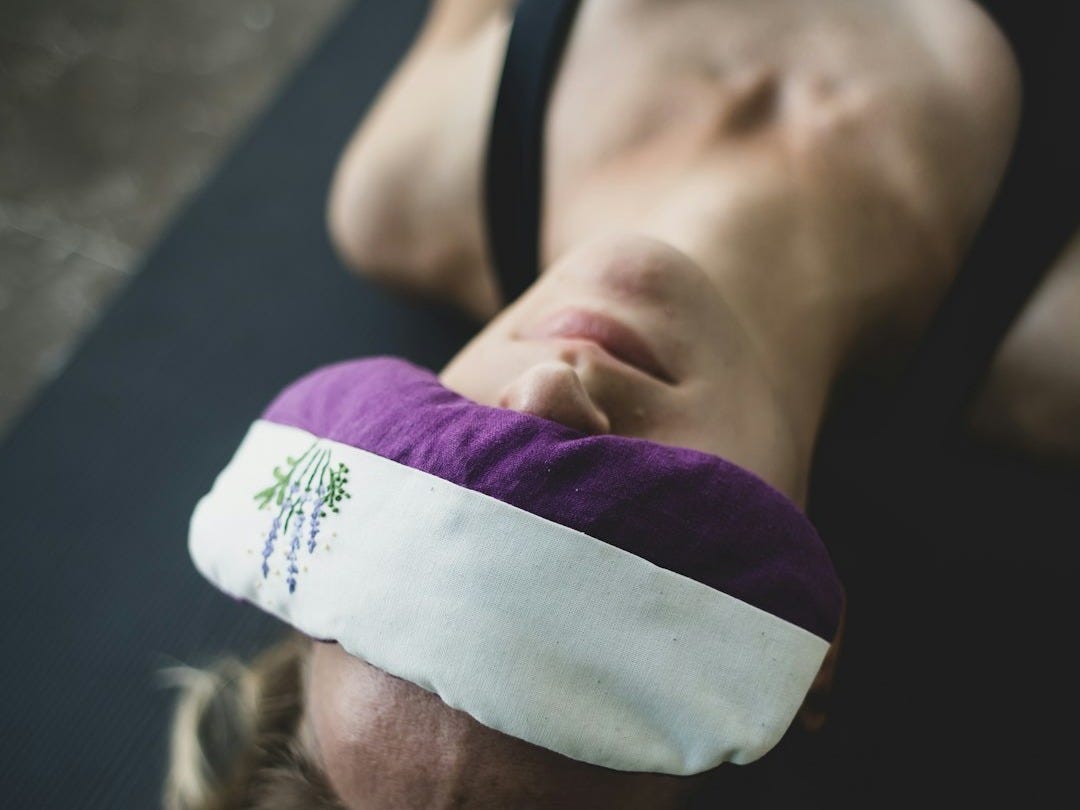
First of all, it feels important to say that yoga nidra saved my life. While some wait until their 40s or 50s to have a mid-life crisis, I’m an early bloomer, and thought I’d do this in my 20s in my second year of law school. Joking aside — because I did not consciously choose crisis — this was a concoction that included sexual violation, a diagnosis of fibromyalgia, and dropping out of law school.
It was a time of immense suffering, a time when it became clear that any possibility of becoming the perfect Chinese daughter my immigrant parents wished for, was not going to happen.
(In hindsight, I understand this moment as some sort of epic intervention. My ancestors had other plans for me. Healing and crisis are two sides of the same coin.)
For 6 months, I could not handle light, people, or my own body. I was in constant physical pain, in the dark, overwhelmed with volatile emotions. I could find no ease, couldn’t sleep — I felt allergic to life herself, like being alive was inflammation. Like I was inflammation.
But the doctors couldn’t find anything wrong with me. And so, they diagnosed fibromyalgia, and offered some pills that they said would not cure me, but might make my life easier. I tried them for a day, and woke feeling a frightening mutedness, and decided to try other possibilities1. I dropped out of law school, and enrolled in a RYT-200 hour yoga certification, with the teacher who showed me that my body was not broken2.
And that’s where I tried my first restorative yoga class, and found yoga nidra. It was on a cork floor that my nervous system found something akin to rest, a portal to slip back into water, to retrieve my sealskin soul-skin3.

Now this is not a tidy healing story. My “healing” was (and still occasionally is) messy and wave-shaped — a tangled journey that includes a rhythm of descent into a kelp sea maze — into the internal deep, before surfacing with pearls…before diving yet again.
Descend. Surface. Descend again. Surface again.
Inhale. Exhale. Inhale. Exhale.
Contraction. Expansion. Contract. Expand.
But I did learn to sleep again. And after so many years of sleepless nights, I had access to the internal ocean of dreams again. Where the soul speaks through image and relationship. Where the mind gives way to metaphors that walk sideways.
I slowly rebuilt the possibility of safety inside my body — and restarted a friendship that I continue to journey with, through breath, movement, voice and sound.

My breath is a bridge to an internal wild terrain, that shifts the same way tectonic plates groan. My pain is not just my earth body declaring “too much,” it is also a creature that gets frightened, and often cowers in a prickle bush. But when it senses safety, when my own predatory gaze softens — I’ve discovered it wants to yawn, stretch, and let loose her tail.
Fun fact. Once upon a time, our human ancestors had a tail. As our ancestors transitioned from walking on all fours to upright walking (bipedalism), our tails tucked down and in… and became the pelvic floor.
That place yoga teachers often invite you to squeeze? That’s your tail, honey.
Your pelvic basin, this lowest diaphragm in the gorgeous architecture of your body — continues to support your navigation, if it can move. A permanently frozen tail does no good.
What if re-wilding your inner terrain includes freeing your tail?

“Soma” refers to the living, sensing body experienced from within, which is connected to but distinct from the objective, external gaze imposed upon the body.
Womxn in particular, may understand this gaze well. Suck in your belly! Hide your mouth when you yawn. Be beautiful, but don’t be too beautiful — you might invite attack.
This gaze, these stories, first experienced from the outside, and then over time, internalized into self affliction.
Getting free is hard work. And sometimes, the work is slow, almost tedious. Other times its cathartic, even frightening. Very much like befriending a wild animal, it is a practice that asks for devotion.
The beauty about yoga nidra is that you’re either meditating, cultivating the capacity to stay with your body, or sleeping. It’s a win-win kind of game where you lie around. Maybe you’ll even get bored!
And I don’t know about you, but I could use more boredom in my life.
My understanding and teaching of breathwork has evolved a lot since I started teaching in 2014. And while I believe there is a place for the yogic practice of pranayama, and continue to practice it, I am cautious that pranayama was made for bodies in a very different time4. It was designed for bodies before modernity.
Contained within pranayama5 is a discipline and control of breath…whereas in these modern hyperspeed times, we already have this in excess. What breath could balance our modern life reality? What if we invited the creature inside to pandiculate and roll us off the bolster?

I’ve become deeply inspired by the work of Fides Krucker and Emotionally Integrated Voice6, where we don’t control the breath but cooperate with it. We invite it to unravel us from the inside out. We track it like a wild animal, patiently and without force.
“A person’s voice is emotion laid bare…it is the perfect instrument of self-betrayal, of exposure.” ~ Fides Krucker
How much do we hide what’s happening on the inside? Is our breathing healthy, and what is our body’s capacity to house the emotions we feel? What’s possible with intentional scaffolding? Can we let emotions blow through?
And while not every yogi takes to singing and sounding, most yogis are used to sighing in class together.
What happens when we invite the sigh of relief?
What about…a sigh of pleasure?
What about yawning without restriction or apology?
How are you breathing right now?
Is your tail tucked or loose?
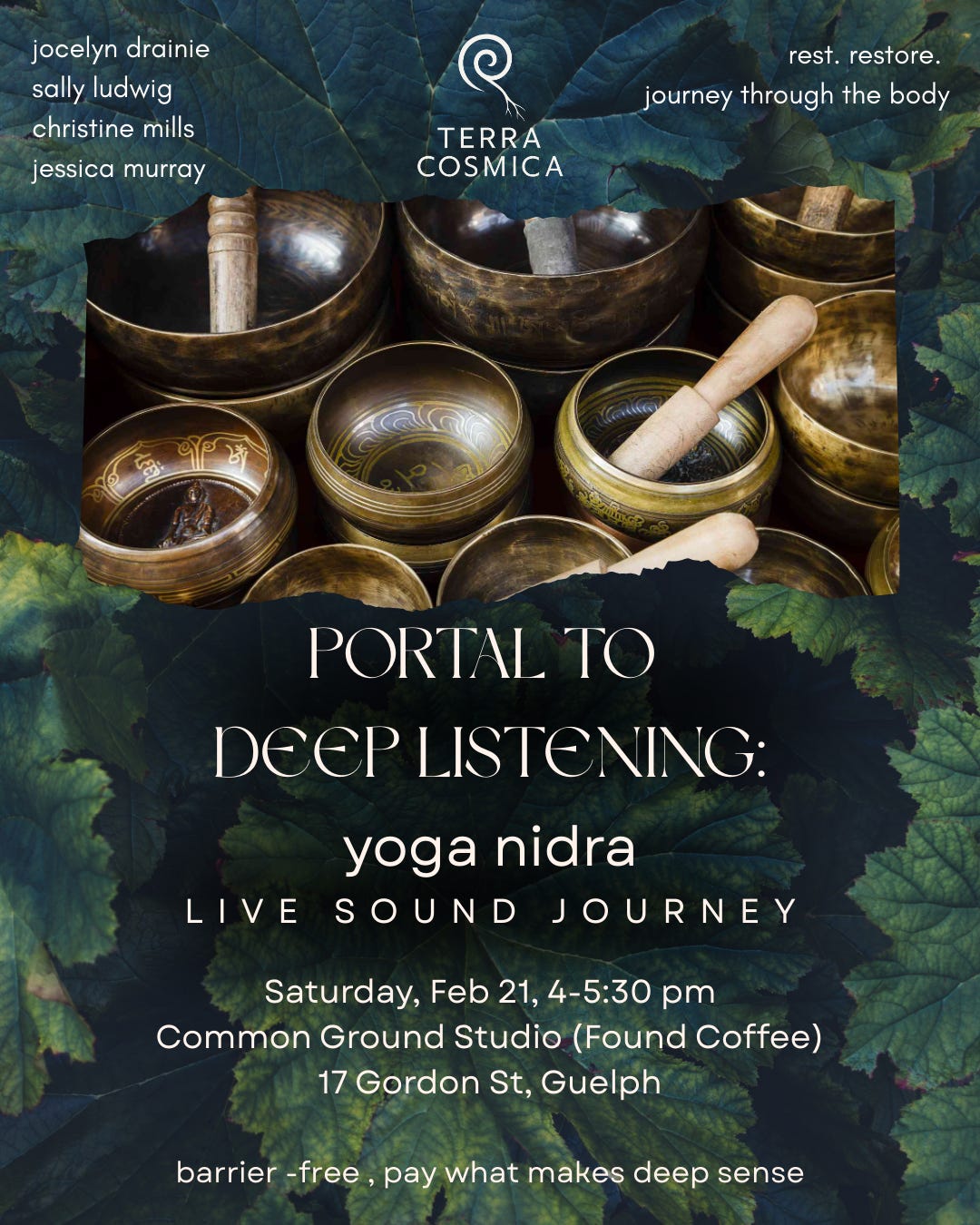
This Saturday, February 21, these worlds weave into a 1.5 hour journey assisted by live meditative instruments. Where somatic practice, and rest, is held by music as medicine.
More information here.
Or…if a regular monthly subscription doesn’t work for you, perhaps you would like to
This is not to say that pharmaceutical interventions and pills are not important or bad. I don’t judge anyone for going this route. There is a time and place for every intervention as we gesture towards wellness.
My training was completed in the summer of 2014 with Mona Warner, at Janati Yoga in Kingston, Ontario. I would also go on to learn Thai Yoga Massage, and take workshops for teaching yin yoga with Tracey Sohgrati. The classes I’ve taught focus on gentle, restorative, and somatic-based practice. I started with the premise that each body actually knows what it needs — can we learn to listen better?
I am referencing Clarissa Pinkola Estes’ book, Women Who Run With Wolves and a story found in this anthology of myths for women. This story of selkies, who are mythological creatures rooted in the histories of the Scottish, Irish, and Icelandic.
Pranayama as a practice began around 1500 BCE.
Pranayama. Prana = life force + breath. Ayama: Means to stretch, extend, prolong, or expand. Yama: Means control, restraint, or discipline.
To be 100% clear, I am not in any way saying I am a teacher of Fides Krucker’s Emotionally Integrated Voice method. That being said, her work has meaningfully shifted my experience of fibromyalgia. I cannot help but draw from it when I guide breathwork. Teachers you can reach out to are Lesley Greco and Shannon Kingsbury, or Fides herself!